How to Choose the Right Language Course
Your guide to understanding which IB language course fits you best.
Vero is Head of IB Languages at RV. She holds an Educational Bachelor's degree in Secondary Education. She has 25+ years of teaching experience in international schools in Argentina and Belgium, is an IB Language and Literature examiner, and is an IB workshop leader.

It is the end of MYP5 or grade 10, and you need to choose your IB subjects. You are considering different university choices and paths. However, there is something you cannot escape: Language.
The IB requires all students to take (at least) a Language from Group 1: Language and Literature. After this first choice, the rules are quite flexible: you can take a second language course from Group 1, or you can take a Group 2: Language Acquisition course, which can be taken at HL, SL, or ab initio level. You can also add a third language to replace a Group 6: The Arts subject.
Taking more than one language from Group 1 ensures you have a bilingual diploma. However, this is not the only path to a bilingual diploma. If your Group 1 Language is different from the language in which you will take some of your exams, you will also be awarded a bilingual diploma.
All these are highly dependent on the choices you make for the rest of your subjects, so make sure you consult with your DPC before making a final choice. However, a common question is: Which is the correct course for me?
We’ll try to help you solve this conundrum. 🙂
Choosing the right combination is only half of the decision. Each language must be taken at the right level. Look at the following table:
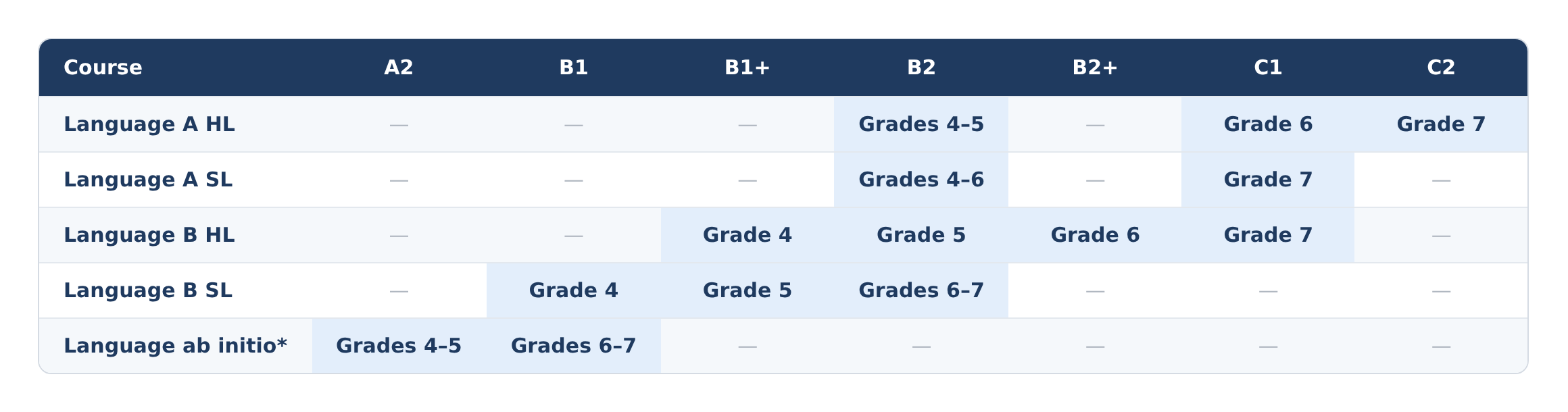
Reference: https://ibo.org/research/assessment-research/research-studies/cefr/
The table provides a rough approximation of grades and their relationship to CEFR levels. You can learn more about CEFR levels here. Remember, the table relates to the level achieved at the end of the 2 DP years, not the level expected or required at the beginning.
In other words, you don’t need to be at B2 on day one to take Language B HL. You need to be at a point where the course will stretch you without leaving you behind. Teachers call this the zone of proximal development, an idea from the psychologist Lev Vygotsky. It’s the space between what you can do on your own and what you can do with some support. Tasks in that space feel challenging but manageable, and that’s where real progress happens.
So think of your placement as a starting point. If a course feels too easy from the first week, you’ll learn very little. If it feels impossible, you’ll spend your energy just trying to keep up. The right course sits in between, and over two years, it will take you from where you are now to the levels in the table.

Group 1: Language and Literature
These courses are designed for students who can already use the language in academic contexts, can understand subtleties, and can write detailed and accurate texts.
Here are some guiding questions to consider before choosing a Language A course:
- Are you an independent reader?
- When you read a novel, poem, or opinion piece, can you explain both what it says and why the writer chose particular words or techniques?
- Can you speak fluently and clearly in different settings?
- Can you write a detailed, well-organized essay in this language?
- Can you adapt your writing to different audiences?
- In a class discussion, can you follow everything and share your ideas, even if the hardest questions still make you pause?
If you answer mostly yes, you belong in the Language A course.
Read this blog to choose which Language A course is best for you.
Group 2: Language Acquisition
Language B HL
This course is designed for students who can understand texts well and can speak clearly. The biggest difference with Group 1 is analysis and nuance.
Here are some guiding questions to consider before choosing a Language B HL course:
- Can you understand the main message of articles, videos, or podcasts in this language without translating every word?
- Can you write a clear, organized text, like an email, a blog post, or a short article, that mixes simple sentences with some more complex ones, mostly without mistakes?
- Do you have an understanding of basic and some complex grammatical structures?
- Do you generally have words to say what you mean when speaking or writing about a variety of subjects?
- In a conversation, can you answer most questions and add your own ideas, even if the really difficult questions still trip you up?
Mostly yes? Then, take the Language B HL course!


Language B SL
This course is for students who can communicate in everyday contexts using basic structures and vocabulary.
Here are some guiding questions to consider before choosing a Language B SL course:
- Can you understand the general meaning of everyday texts and audio in this language, such as messages, short articles, or announcements?
- Can you write a short text about a familiar topic, like school, hobbies, or your town, with connecting words such as “because,” “but” and “then” correctly?
- Can you use simple grammatical structures accurately?
- Can you hold a simple conversation on familiar topics, understand what’s asked, and get your message across clearly most of the time?
If you answered yes to most of these questions, choose Language B SL.
If you have very little experience or exposure to a language, you should consider taking an ab initio course. If you have studied the language for two years or more, ab initio is not the right course for you.
Here are some guiding questions to consider before choosing this course:
- Have you never studied this language at school, or only had a short introduction, such as a few months or a taster course?
- Would you struggle to introduce yourself, or to understand basic phrases like greetings or everyday vocabulary like numbers, colors, or school objects?
- If you saw a short paragraph in this language, would you understand very little of it without a dictionary?
Putting it all together
Ready to decide? Follow these steps:
- Make a list of every language you know, and be honest about how well you know each one. Think about reading, writing, speaking, and listening.
- Answer the guiding questions above for each language.
- Build your combination: one Group 1 language, a second language from Group 1 or Group 2, and maybe a third language instead of an Arts subject.
- Look at your full subject list. You need three subjects at HL, so check how your language choices fit with the rest. Remember that ab initio is only offered at SL.
- Talk to your DPC and bring your answers to the guiding questions. They can tell you what your school offers and what works with your timetable.
There is no single combination that is “right” for every student. Two students in the same school will have totally different language profiles. The most important decision is that your choices sit at the level where you will grow.